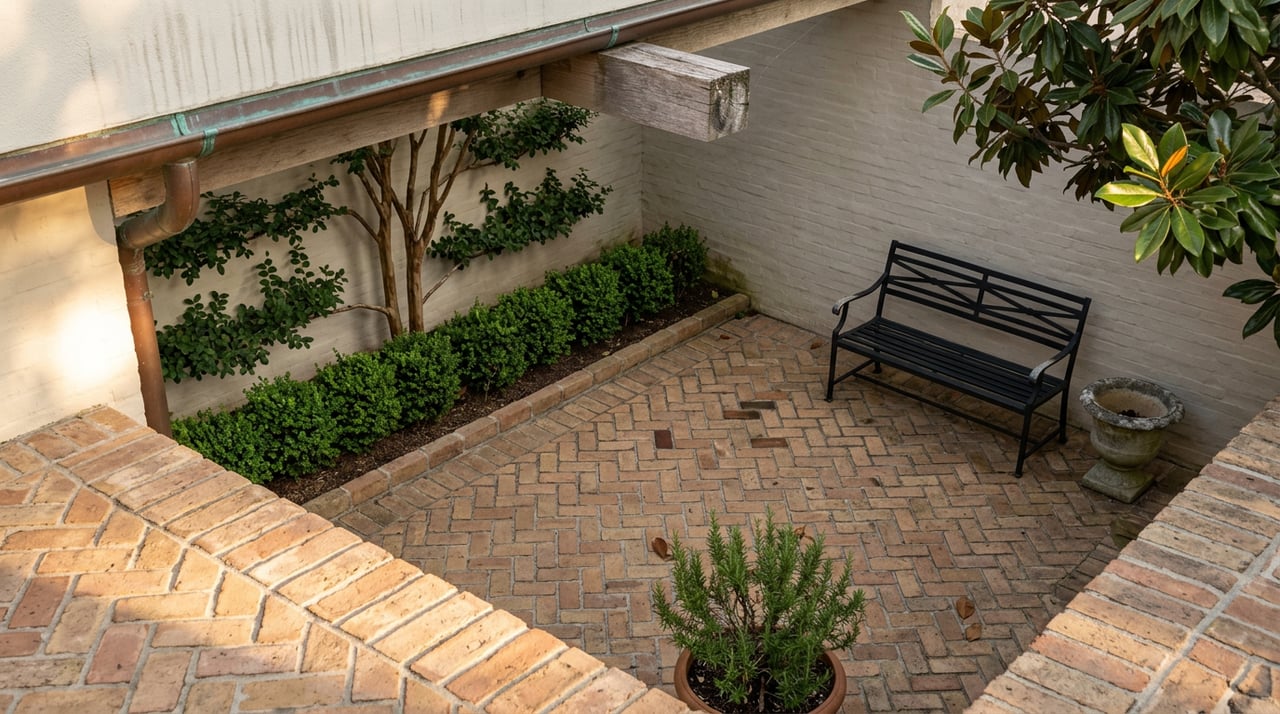
Lafayette spent the spring watching Moncus Park unveil a meditation garden. Cameras came out. A feng shui-influenced design tucked behind the Oak Allée, gifted by a family with the means to build something quiet and lasting, made for an easy story. What got less attention, opening in the same stretch of weeks, was a roof.
That roof is the thing that actually changes what a Saturday morning at the park feels like this fall.
Three Projects, One Spring
Moncus Park opened three capital projects within roughly a month of each other in 2026. The Kergan Meditation Garden had its ribbon cutting on May 17, a feng shui-guided space organized around the five elements of the Bagua Map, designed by landscape architect Michael Cullen and funded by Ted, Ann, and Jean-Luc Kergan. Around the same time, the park opened the Paul A. Doerle Sr. Farmers Market Pavilion, a permanent covered structure built specifically to house the Lafayette Farmers and Artisans Market. The b1BANK Backyard, a planted grove of overcup oaks meant for lingering rather than programming, opened alongside it. The park also added restrooms and expanded parking to handle the traffic all of this was clearly expected to bring.
Ann Kergan spoke at the garden's opening about wanting a place where people could step away from the noise of ordinary life and get grounded again. It is a genuinely lovely space, and it will matter to the people who use it. But the meditation garden asks something of the visitor: a decision to go there, on purpose, for stillness. The market pavilion asks nothing. It just sits over a market that was already happening every Saturday, and removes the one variable that used to shut it down.
What the Pavilion Actually Solves
For as long as the Lafayette Farmers and Artisans Market has run at Moncus Park, it has run outdoors. Rain meant a shortened market, or vendors packing up early, or a Saturday morning where regulars showed up to find half the usual tables missing. That was the tradeoff of a market built in an open field: character on a clear day, a coin flip on a wet one.
The Doerle Pavilion changes that math. Vendors now set up under permanent cover, which means the market that anchors most Saturdays in this part of Lafayette, the one with the weekly Cajun jam and the line for boudin balls before 9 a.m., no longer answers to the forecast the way it used to. For a market that has spent years building a producer-only reputation, meaning everything sold has to be grown, raised, baked, or crafted by the person standing behind the table, a stable home is not a small upgrade. It is the difference between a market that survives a wet week and one that quietly loses vendors to it.
If you have lived near Moncus Park long enough to have a favorite bread vendor or a regular fish supplier, this is the change that actually touches your routine. The meditation garden is a destination. The pavilion is infrastructure.
Where the Rest of the Programming Moved
The spring build-out did more than add buildings. It gave the park new named spaces that its recurring programming has started to use, which means some of the events that Lafayette residents already know are happening in different corners of the property than they used to.
Blakewood Oaks, one of the newer gathering areas, has become the home base for two of the park's longest-running community programs: the monthly Garden Talks led by Lafayette Parish Master Gardeners, and the Community Drum Circle hosted by the musical trio TRINITY. The First Horizon Amphitheater, built out with the same wave of construction, now carries the Turn-Up Dance Fitness sessions, a Hip-Hop-based workout series that draws a different crowd than the drum circle but pulls from the same expanded footprint. None of these programs are new to Moncus Park. What is new is that the park finally has enough built structure to stop routing everything through the same open lawn.
That matters for anyone who treats the park as a weekly habit rather than an occasional outing. The geography of a Tuesday evening walk-through has shifted. You are no longer as likely to stumble into three unrelated events happening on top of each other near the entrance.
The Thursday Nights That Tested the New Layout
Before fall programming had a chance to settle into these spaces, summer gave the park a trial run. Sunset Sessions launched in June as a free Thursday night concert series at the Doerle Pavilion and the b1BANK Backyard, pairing live music with food trucks and free dance lessons led by local instructor Britlyn Delahoussaye. It was the first sustained test of whether the new spaces could hold a crowd on a weeknight, not just a Saturday morning market.
By most accounts it held. Moncus Park has continued to lean on the pavilion and backyard as its primary evening venues through the summer, which is a meaningful signal heading into fall. A park that built new infrastructure and immediately proved it could support recurring weeknight programming is a different park than one that built it and hoped.
What Fall Actually Looks Like Now
Fall at Moncus Park has always had a rhythm. Tour de Lafayette group runs circle the park on weekend mornings, followed by a social back at the market. Autumn in the Oaks brings the year's biggest family-oriented festival, with hayrides and seasonal activities filling the lawns. Food Truck Friday Night Out closes out the calendar with a grand finale that pairs food trucks with live music and a bar that stays open into the evening.
What is different this year is the setting all of that runs through. The market that anchors Saturday mornings now runs under a permanent roof. The evening programming that used to compete for the same patch of grass now has the amphitheater and the backyard to spread into. The garden talks and drum circles have a dedicated home in Blakewood Oaks instead of whatever open space happened to be free.
For someone who already treats Moncus Park as part of their week, that is the real story of this fall. Not a new attraction to add to the list, but a park that finally has enough built structure to stop feeling like everything happens in the same spot at the same time.
If your Saturday morning already includes a walk through the market, expect it to feel different this year, in the way a favorite restaurant feels different after a renovation you weren't asking for. The bones are the same. The room finally fits what it has been asked to hold.
Whether you are shopping for produce, catching a Thursday night set, or just walking the trails on a cooler evening, the park you knew before May 2026 is still there. It just has more places to put people now, and one less reason to shut down when it rains.
If you are thinking about what it means to live near a park that keeps investing in itself like this, or you are weighing how proximity to Moncus Park factors into a move within Lafayette, Sylvia McLain and Cody Musgrove know this part of town well enough to talk it through. Let's Connect.